
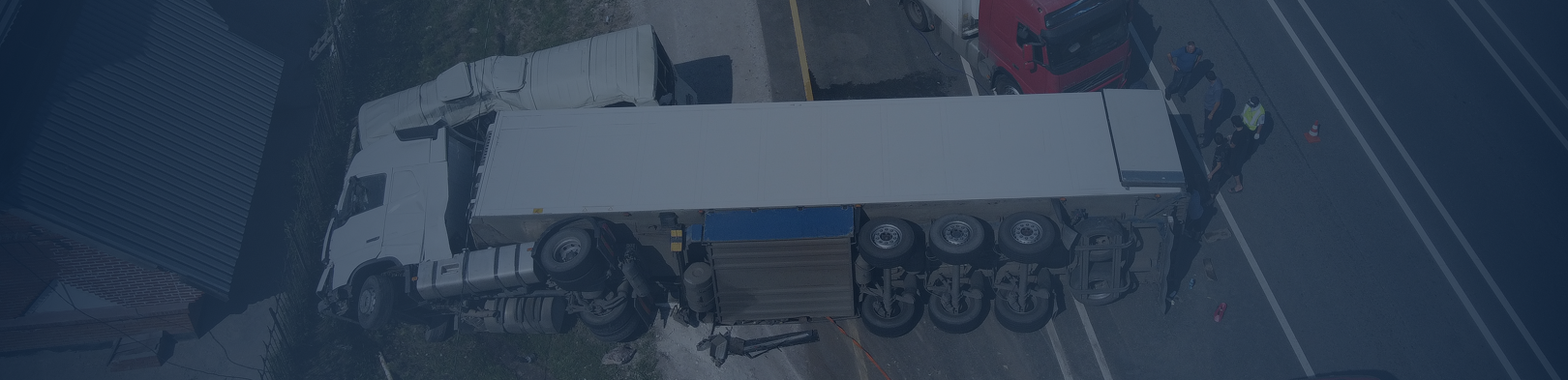
 Every truck accident is different. The law that applies to these crash cases is intricate and complicated. Even the smallest change in facts can make a huge difference in the eyes of the courts in New Jersey and New York.
Fortunately, many common questions about truck accident law can be answered here. For more detailed answers to your questions, call 1-800-LAW-2000 or use our online form to speak to a truck accident lawyer at Davis, Saperstein & Salomon, P.C., about your case.
You are out of luck unless your case is a workers’ compensation case. Once a case is settled, the defendant is relieved of any further responsibility and payments.
Yes, under NJ’s dram shop laws, if the bar over-served a visibly intoxicated person.
Medical records, objective medical tests such as MRI studies, EMG studies, together with expert opinions, and testimony help link injuries to the accident.
You can still recover damages if the accident aggravated your condition, especially if your pre-existing condition was asymptomatic.
Yes, if it’s related to accident-related trauma and prescribed by a provider. People often suffer from PTSD and anxiety while driving.
No, unless it exhausts the full insurance coverage and you do not have UIM coverage in excess of the defendant’s coverage. Initial offers are often low. Consult a personal injury attorney before accepting.
Generally, personal injury settlements for physical injuries are currently not taxable.
Yes. Many lawyers routinely negotiate with providers at the conclusion of your case to reduce bills and maximize your net recovery.
You may still recover lost earning capacity if the injury affects future work ability. This gets a bit tricky if you are a gig worker or rely mostly on tips. Under those circumstances, your tax records may be relevant and helpful.
It holds bars or restaurants liable if they serve over serve alcohol to visibly intoxicated persons who then cause a crash resulting in injury or death. The laws also apply to liquor sales to minors.
An annuity payout over time rather than a lump sum, often used in larger cases or for minors. If done properly, a structured settlement is tax-free.
Yes. You may have both a workers’ comp claim and a third-party lawsuit. If you are injured in a company vehicle, your employer’s workers’ compensation carrier will select your treating physicians.
Yes, but you must file a special notice of claim with the appropriate governmental agency within 90 days of the accident.
Yes. Claims may be against the school district, requiring special procedures and deadlines and are subject to the New Jersey Torts Claims Act.
You may still bring a claim under NJ law if the crash occurred in the state. In fact, under New Jersey’s “Deemer” law, you may be entitled to up to $250,000 in medical coverage.
Yes, under a product liability theory, if a defect contributed to your injuries. You must take action to preserve your vehicle prior to repair.
Most claims are denied based on liability and causation, meaning that the injuries were pre-existing. You then need to file a lawsuit with the help of a skilled and experienced personal injury lawyer.
After being hit by a truck on a New Jersey roadway, you may think that any lawyer who handles car crashes is the right choice for your case. However, there are many differences between car crashes and truck accidents in the eyes of the law.
There may be more parties involved, including interstate trucking companies and mechanics. There are many more relevant laws, including federal labor laws and transportation regulations.
The damages also have the potential to be much larger because trucks are bigger, and insurance policies are much more extensive. An experienced New Jersey tractor-trailer wreck lawyer can help you navigate the confusing legal maze that stands between you and peace of mind.
Yes, immediately. A police report is crucial for both legal and insurance purposes. Look for cameras and witnesses in the area.
Yes, if their driver was negligent or their policies contributed to the crash. This is known as a negligent entrustment case. In general, commercial establishments like trucking companies are responsible for the negligent acts of their employees, and in some cases, their independent contractors.
Yes, they must follow federal and state commercial driving regulations. Depending upon the size and classification of the vehicle, a truck could require a commercial driver’s license, or a CDL license.
Seek medical care, report it to police, take plenty of photos at the accident scene, and contact a New Jersey lawyer experienced in truck accident litigation.
Davis, Saperstein & Salomon, P.C., will work to hold the driver and sometimes the trucking company responsible. It is also possible that shipping companies, truck manufacturers, parts manufacturers or even a mechanic can be liable. Sometimes, the owner of a trailer or even your employer may be responsible. In many cases, one or more insurance companies end up paying.
Our firm will work to find out who is responsible for your injury so they can be held accountable in court. Some of your recovery may even come from your own insurance company because of uninsured or under-insured motorist provisions of your own insurance policy. See our No-Fault Insurance page for more information.
New Jersey law allows family members to sue in a wrongful death claim. Family members may be able to recover funeral and medical expenses, lost wages and other costs associated with losing the financial support of the deceased. Witnesses of deadly accidents may also be able to sue. Talk to a New Jersey truck accident lawyer for more details.
In most New York and New Jersey truck accident cases, Davis, Saperstein & Salomon, P.C., will use the services of multiple experts to help you recover. Product defect, accident reconstruction and trucking industry experts can help you show that another person or company was at fault. After these experts show the cause of your injuries, biomechanical, medical and economic expert witnesses can help prove the costs of your damages. The cost of these experts is paid for in advance by Davis, Saperstein & Salomon, P.C., under the terms of your representation agreement with the firm.
Our lawyers make use of experts to reconstruct accidents for the purpose of showing who was at fault. This can be quite complicated when it was our client whose death was caused by a truck driver’s negligence. We can review maintenance records to determine if there were any mechanical problems with the truck. Log books will reveal instances of drivers breaking labor laws and driving while fatigued. Even E-ZPass records and traffic cameras can be used. We will also hire a variety of experts.
The lawyers at Davis, Saperstein & Salomon, P.C., have years of experience in showing that truck drivers are at fault. If you were hurt due to the negligence of a trucker or a shipping company, it is our mission to help you recover in court.
Trucks have massive blind spots, also known as “no-zones.” No-zones are found on the sides, rear and front of large trucks. While many trucks use additional mirrors to reduce the size of their no-zones, any vehicle traveling close to a truck’s no-zones has a higher risk of being hit.
Trucks are also more likely than cars to veer out of their lane because of their size. This is especially true during turns. Wide turns are one of the most dangerous ways to be hit or crushed in a no-zone.
Commercial trucks are trucks used by companies to transport goods. A commercial truck can weigh up to 40 tons loaded. Types of commercial trucks include tractor-trailers, big-rigs, 18-wheelers, dump trucks, logging trucks, freight trucks and many others. Special laws and regulations apply to commercial trucks and their drivers.
Every lawsuit is entirely different, but New York and New Jersey tractor-trailer wreck injury cases are generally resolved over the course of a few months to three years.
Driver fatigue, speeding, improper turning, improper maintenance, overloaded cargo, and distracted driving. In serious truck wrecks, this can often be proved by expert professional analysis of a truck’s computer data recorder or “black box.”
You have two years to file your case under New Jersey’s statute of limitations. Minors under 18 years old at the time of an accident will have until their 20th birthday to file a case. In New York, you will have three years to file, except in cases of wrongful death, in which you will only have two years. In truck accident cases in New York, a minor will usually be given until his or her 21st birthday to file.
It is important to contact a lawyer at Davis, Saperstein & Salomon, P.C., as soon as possible to allow for time to build your case and consult with experts before filing. Failure to file on time usually prevents any type of recovery. However, if the truck was owned by the federal or state government, including any of their agencies, counties, towns or municipalities, then a “Tort Claim Act” would apply to your case. These acts require you to put the government on notice of your intention to make a claim by providing the details of your claim in a special form called a “Tort Claims Notice.”
In New Jersey, this notice must be done no later than 90 days after the accident. To find out about federal or state “Tort Claim Act” laws, contact our firm right away.
There is no need to worry about paying for a lawyer. You only have to pay if you recover money. The American legal system allows for payment of a lawyer on a contingency fee basis. This means you do not need any money to hire a personal injury lawyer. The lawyer gets paid from any money you win in court or in a settlement, and only if you recover money first. When Davis, Saperstein & Salomon, P.C., takes a case, there is almost no risk to you. You will only pay us if you get paid.
Yes, attorney Marc C. Saperstein handles New York tractor-trailer wreck cases in addition to New Jersey cases. No matter where you were injured, you should contact the firm of Davis, Saperstein & Salomon, P.C.